This article is the first in a series of “Moon Joy” posts. Over the month of June I will be following the prompts from NASA’s Moon Joy June challenge, sharing four different aspects of the historic Artemis II mission. This week, launch.
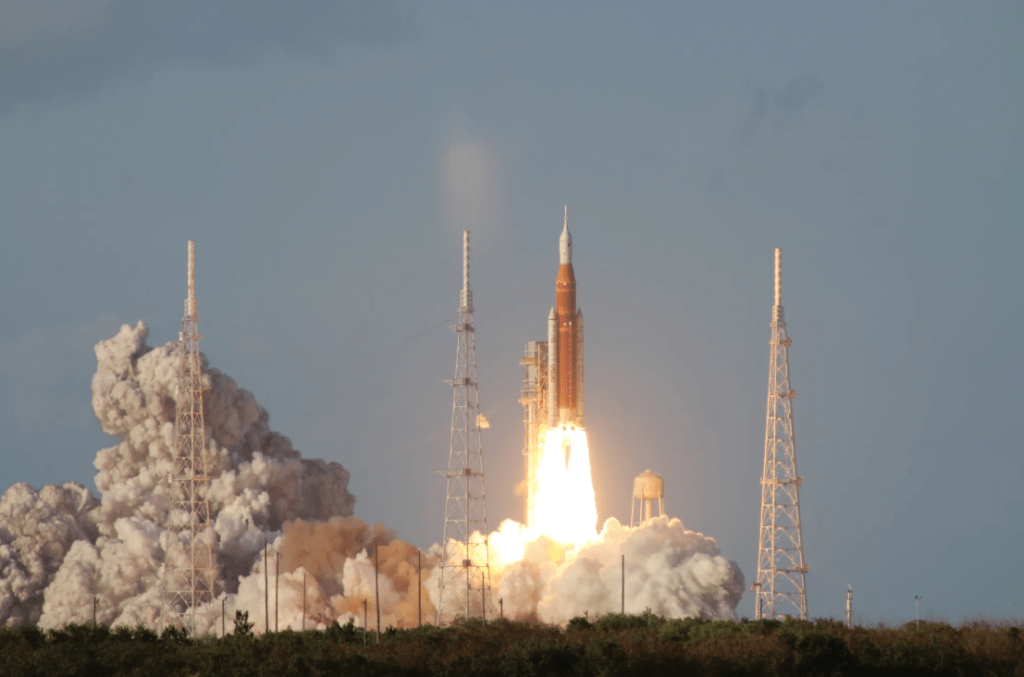
The most powerful rocket NASA has ever launched, the first mission to the Moon, and the first mission beyond low Earth orbit, since 1972. A historic launch on April 1st, 2026 brought the world more than just science, it brought about a shared experience world wide. A type of unity that hasn’t been felt for a long time. Rather than the fear and anger over various political regimes that unites so many across the world right now, this unity was based in excitement and joy.
Perhaps you remember where you were when Artemis II launched. I do. Unfortunately, I wasn’t watching live, as I was driving down the Hume Highway to go visit family in Victoria, Australia. But I remember checking for updates at my first rest stop. Opening my phone with bated breath, and crying out with joy and relief when I learned the launch was successful. Our beloved astronauts were safely in space, and their 10 day voyage could begin.
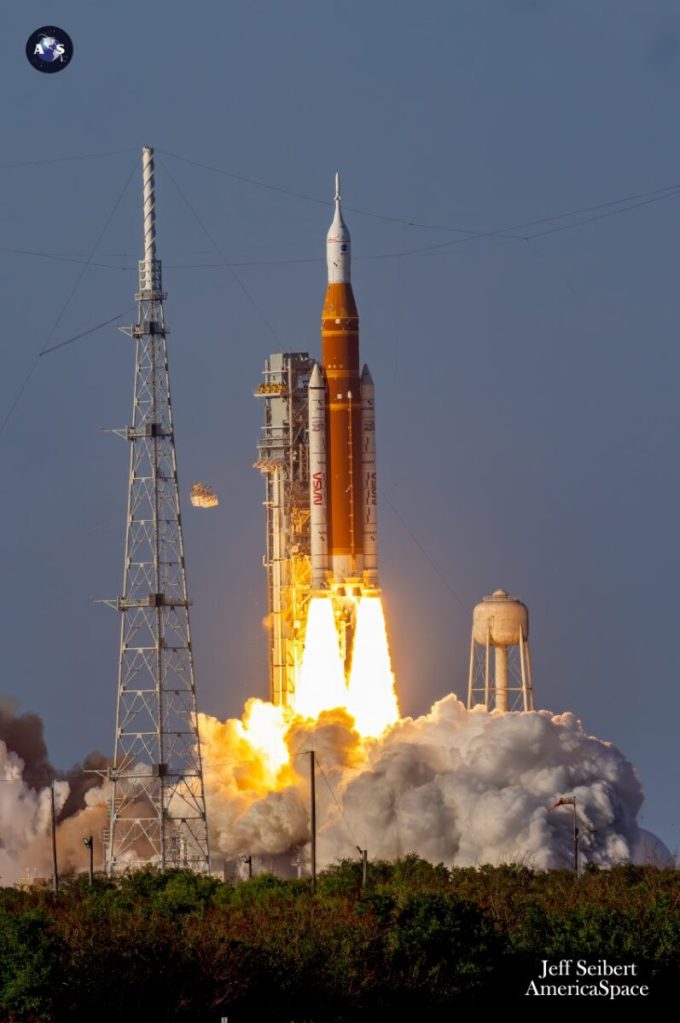
But how did they get to space? If you’ve seen the video of the launch (you can recap it right here), you’ll notice that the rocket is enormous! How could such a big object get into space, and why did it need to be so big?
The rocket weighed roughly 2.6 million kg. This meant it needed around 39,000 kilonewtons of thrust to get off the ground and up out of the atmosphere, which is huge! Thrust is the pushing force that propels and object forward or upward, and that pushing force comes from the force of the fuel going downwards. It follows Newton’s third law of motion: “for every action there is an equal and opposite reaction.” It’s like if you sat on a wheely chair with a fire extinguisher. As the extinguisher sends material one way, you travel the opposite way. Now, if you’d rather not (or aren’t allowed to) get a fire extinguisher and try this yourself, you can watch demonstrations of this on Youtube. Or check out this cool video demonstrating this concept from space!
So, to get an idea of the immense power of this rocket, 39,000 kilonewtons of thrust is the same as 132 individual Boeing 747 engines! This size was necessary due to the need for 2.76 million litres of liquid fuel, plus 1.27 million kg of solid fuel for launch! Then you also have to factor in room for the Integrity capsule that took the astronauts all the way to the Moon, as well as an extra 85,171 litres of liquid fuel that’s used to push the spacecraft out of Earth orbit once it’s in space. It ends up being a bit of a cycle. You need a certain amount of fuel for lift off, which means you need somewhere to house the fuel, which makes the rocket heavier, which means you need more fuel. You get the picture… But engineers are able to find a happy point, a size to weight ratio, where the size of the rocket and the fuel required to get that rocket to space all balances out.
Getting a rocket into space is no easy feat. To break through the atmosphere and go into orbit, a rocket must escape Earth’s atmosphere. To do that, it must travel at a speed of around 28,000 km per hour (km/h), and if it needs to escape Earth’s gravity all together and leave orbit, it must travel at a speed of around 40,000 km/h! Artemis II achieved low Earth orbit from a speed of 27,359km/h before accelerating to a speed of 39,472 km/h in order to escape Earth’s gravity and send the astronauts to the Moon. This maximum speed is also known as Mach 32, which is how you may have heard it referred to during launch. A Mach number is a ratio of an objects speed to the speed of sound. So Mach 1 is equal to the speed of sound, whilst Mach 32 is 32x the speed of sound! A rocket is considered hypersonic at Mach 5, while commercial airlines fly at around Mach 0.78-0.85. Fighter jets can reach Mach 2.5. So, Mach 32 is something I’d consider pretty fast!
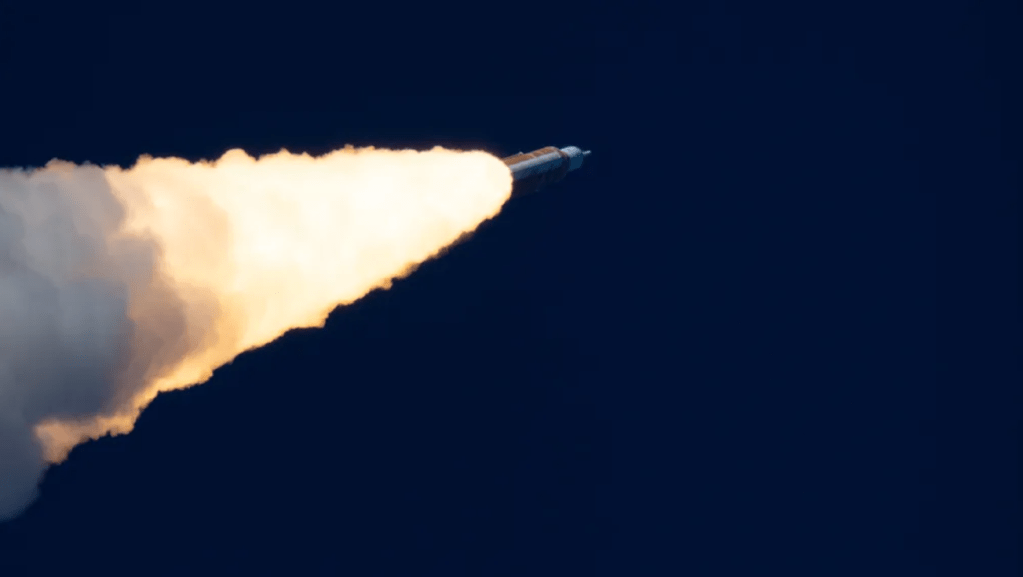
So you’ve got an enormously heavy rocket going at unfathomable speeds. Imagine how it must have felt to be inside that rocket?
Well, the astronauts would experience an immense amount of shaking and noise. Think of an earthquake room at a science museum but way more intense, with deep rumbling, like never ending thunder, from the engines. As the astronauts begin to lift off, they experience something called G force. This is the force of gravity. Gravity is a pulling force, where a heavier mass pulls a lighter mass towards it. Gravity is what keeps us connected to the Earth, and why we can only jump so high. So, as the astronauts attempt to escape this pulling force, they can physically feel gravity trying to stop them from escaping. It’s like if something heavy is sitting directly on your chest. Perhaps you’ve felt this feeling on an amusement park ride, where you feel really heavy for a moment before you suddenly drop. That drop is called freefall, and can make you feel weightless. This is the next thing the astronauts experience. Once they’ve escaped Earth’s gravity, they experience microgravity. They feel weightless as they float around the spacecraft, as there is such a minimal pulling force keeping them connected to any single surface. Launch is complete.
So that’s launch. From deep rumblings and unimaginable shaking, to immense weight from gravity trying to keep the astronauts from leaving Earth, to floating effortlessly around a spacecraft. All within about 8 minutes. While it sounds intense, I also imagine it would be an incredible, surreal experience. It certainly would be an out of this world adventure!


Leave a comment